
The Defense Industry: A Driver of Economy and Innovation
The Brazilian defense industry stands today as one of the national economy’s most strategic areas. Accounting for approximately 4.8% of GDP, the segment comprises over 250 companies and generates roughly 3 million direct and indirect jobs, with a particular emphasis on engineers, technicians, and specialists in cutting-edge fields such as avionics, cybersecurity, satellites, radars, and embedded systems.
Beyond guaranteeing sovereignty, the Defense Industrial Base (DIB) functions as a powerhouse for economic development. Every R$ 10 million invested in defense projects yields R$ 18.6 million in direct and indirect effects, in addition to creating approximately 150 new jobs. This is because major programs, such as PROSUB (submarines), SISFRON (border monitoring), and the Gripen F-39, mobilize supply chains across different regions of Brazil, stimulating local small and medium-sized enterprises.
Defense as a Vector for Technological Innovation
Another crucial aspect of the defense industry is its capacity to generate innovation. Projects such as Link-BR2, developed in partnership with AEL Sistemas, and the integration of technologies into the Gripen fighter have established new standards in encrypted communication and high-resolution displays. These innovations often generate spin-offs for civil society through a process of technology transfer.
Examples abound: navigation systems developed for the Super Tucano fighter have inspired solutions in commercial aviation, while military satellite technologies have expanded broadband access in remote regions. With every new defense demand, pathways open for other industries such as transport, healthcare, telecommunications, and education.
Industry Challenges and Opportunities
Despite these advancements, the defense industry faces historical challenges. Reliance on public budgets, bureaucratic hurdles in financing, and international competition are obstacles that demand consistent industrial policies and a long-term vision. In parallel, the sector must invest increasingly in cyber defense, artificial intelligence, and autonomous systems, all of them areas that will define the future of global security.
Nevertheless, the Brazilian industry is already showing signs of recovery and expansion, marked by rising exports and the consolidation of technological hubs in states such as São Paulo, Rio de Janeiro, and Rio Grande do Sul.
40 Years of ABIMDE: The Voice of the Defense Industrial Base
In that scenario, the Brazilian Association of Defense and Security Materials Industries (ABIMDE) celebrated its 40th anniversary in 2025. Created to integrate and strengthen the nascent DIB, the entity has accumulated milestones such as participating in the 1988 Constituent Assembly, formulating the National Defense Industry Policy, and securing strategic incentives through Law 12.598/2012.
More recently, it launched Vision 2035, which outlines future commitments including open innovation in unmanned systems, robust ESG practices, expanding diversity in technical careers, and internationalizing the Brazilian industry in Latin American, African, and Asian markets.
ABIMDE is, therefore, more than an association: it is the vital link between industry, government, and academia, responsible for consolidating defense as a national priority.
AEL Sistemas: Four Decades Alongside Brazilian Defense
The history of ABIMDE is intertwined with that of AEL Sistemas, which also celebrated its 40th anniversary in 2022. Founded in Porto Alegre, the company was born to meet the demands of the Brazilian Air Force and has since become a benchmark in avionics, communications, embedded systems, and Remotely Piloted Aircraft (RPAs).
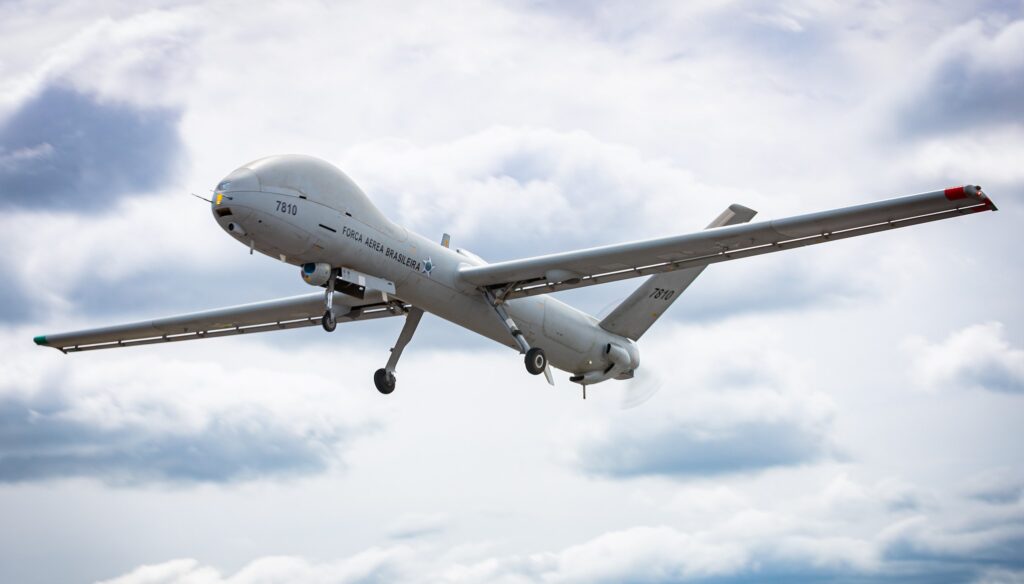
Over four decades, AEL has delivered critical technologies for programs such as the Super Tucano, the KC-390 Millennium, and the Gripen F-39. It is also a protagonist in unmanned systems, with the RQ-450 and RQ-900. In the field of communications, it leads strategic projects such as Link-BR2 and the software-defined radio program (SDR-Defense), both fundamental to the interoperability of the Armed Forces.
With more than 400 highly qualified employees and a 12,000 m² technological hub, AEL maintains its commitment to developing reliable national technology and contributing directly to Brazil’s sovereignty.
While ABIMDE represents the consolidation of the DIB as a strategic sector, AEL Sistemas symbolizes the materialization of this effort through its trajectory. Both stories walk together: both have consolidated defense as an engine of innovation, and both project Brazil as an international reference. More than a historical bond, this synergy underscores that national defense is not solely a military endeavor, but an economic, technological, and societal imperative. Looking ahead, ABIMDE and AEL Sistemas share a unified commitment: to establish the defense industry as a cornerstone of Brazil’s sovereignty, innovation, and sustainable development.